Home › Guides › What height should a changing table be?
Measure once
What height should a changing table be?
The number that decides whether you finish two years of diapers with a sore back, and the two minutes with a tape measure that settle it.
Why height is the thing your back remembers
The right changing height is roughly the level of your hands when your elbows are bent at 90 degrees. That is the position where your spine sits neutral, your shoulders stay low, and your wrists line up with your forearms. You feel balanced, not reaching, not hunched. Now imagine holding that position several times a day, for two years of diapers and outfit changes. The angle of your elbow is what decides whether that routine feels manageable or exhausting.
If the table is too low, you round your back. The curve might not bother you for a quick change, although you will probably notice it on a messy one that takes longer. Over months, the habit of folding forward eats into your lower back, and you feel it at the base of your spine when you straighten up. A height that is off by only a couple of inches asks your back to do the work your hips should be doing.
If the table is too high, you lift your shoulders. Your elbows drift away from that easy right angle, and you start working with raised arms. That leaves tension in your neck and upper back, especially if you are leaning forward to fasten a diaper or wipe under a leg. Again, it does not show up on the first day. It shows up during a growth spurt, when every change takes three extra minutes.
A kitchen counter sits around 36 inches for a reason. It lets many adults chop vegetables with bent elbows and a straight back. A changing table should aim for the same relationship between your body and the work in front of you.
How to measure your own best working height
The simplest way to find your changing height is to stand how you plan to stand during real changes. Start on a flat floor, in the shoes you wear most often at home, or in bare feet if that is more typical. Face an empty wall or the space where the table might live. Set your feet about hip width apart. Relax your shoulders so they fall naturally, without you thinking about them.
Now bend one elbow to a right angle so that your forearm is horizontal. Keep the upper arm close to your side instead of reaching ahead. Let your hand rest as if it were gently cupping your baby’s hips on a pad. That imagined weight changes how your muscles hold the position. It brings you closer to the posture you will actually use at three in the morning.
Ask someone to measure from the floor to the middle of your wrist. A soft tape measure works well here, though a carpenter’s tape and a book can do the same job. You are not chasing a half inch of precision. You are looking for the approximate level where your hands can move without your shoulders climbing or your back rounding.
That wrist measurement is your personal target for the top of the changing pad. Not the frame, and not the guardrail. The soft surface where the baby lies. If your table uses a pad on a deck, remember that the pad might add another inch or so of height. Start from the measured number, then allow yourself a small adjustment up or down for comfort. Your body will tell you quickly which way to move.
What our four heights cover, and how to share them
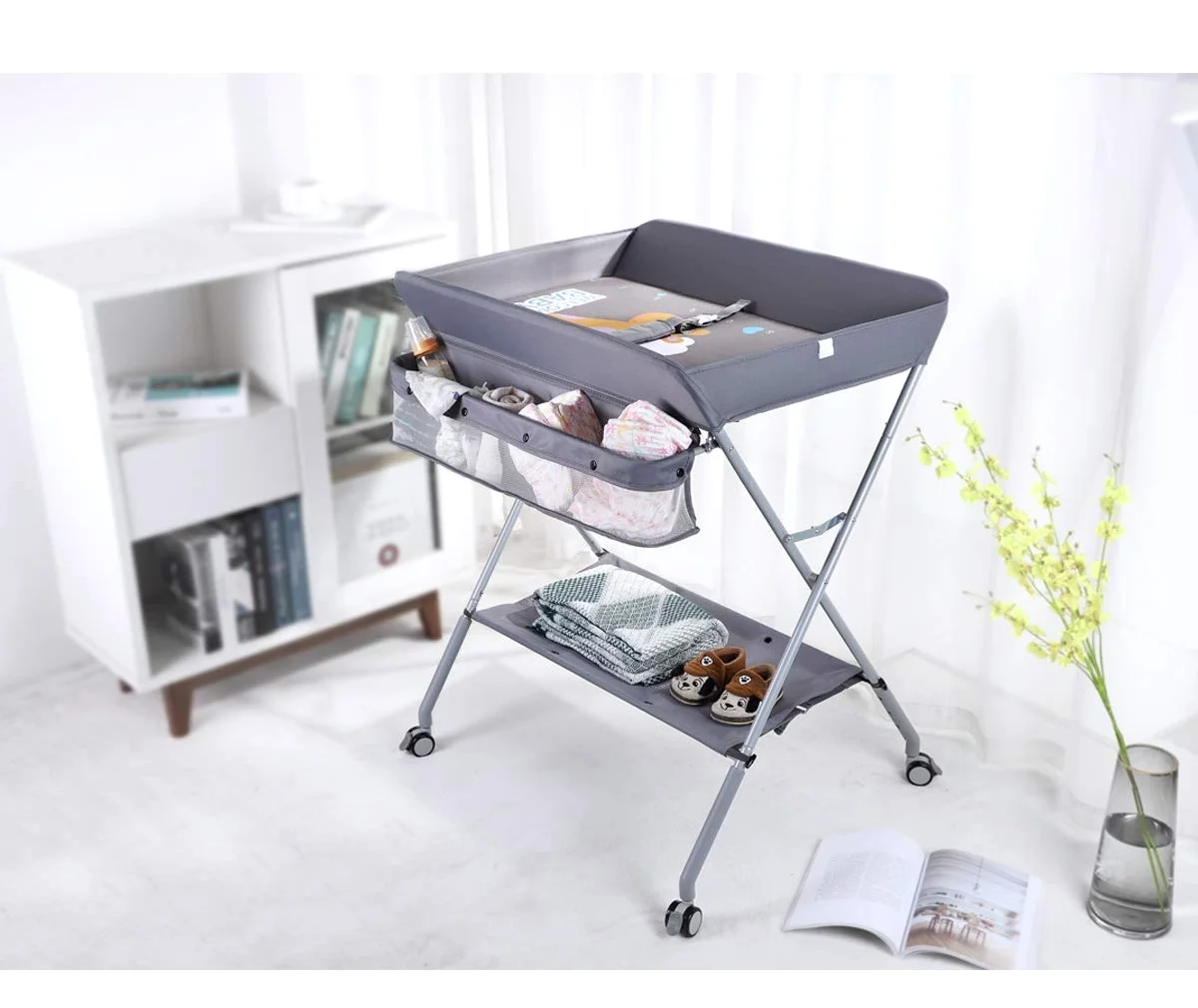
Our changing table lets you step the deck through four working levels between 33.8 and 38.6 inches. Those settings are 33.8, 35.4, 37, and 38.6 inches. The range is designed for adults from about 4 feet 10 to about 6 feet 2. In practice, that means most adults in a home can find a level that keeps their elbows close to that comfortable right angle. The structure under that height is a powder coated steel frame with a working footprint of 29.9 inches by 23.6 inches, so the table feels compact enough for smaller rooms.
If two adults of different heights share the same table, you have a few options. When your measurements fall neatly near two separate settings, you can agree to change the height as you swap shifts. The table is a little over 14 pounds and folds with the lower shelf still loaded, so the frame is light enough to adjust without moving the baskets or your supplies. If the two measurements land between the same two settings, you may both be comfortable meeting in the middle. Your wrists will feel a small difference, but your backs gain the benefit of avoiding extreme angles.
It helps to try each height with an empty pad before your baby arrives. Stand as you measured, rest your hands on the deck, and notice whether your shoulders feel relaxed. You can practice fastening a diaper on a stuffed toy or a folded towel. The goal is not perfection on a ruler. The goal is a setup you forget about during real changes, because your body is not complaining.
What the standards say, and how long a changing table is for
Federal rules in the United States define what counts as a baby changing product and how it should behave under use. The regulation at 16 CFR part 1235 incorporates ASTM F2388 by reference. Under that standard, a changing table is a freestanding structure meant to hold a child of up to 30 pounds. The requirements cover structural integrity, the barrier that stops a child rolling off, where small fingers and limbs can go, and how the restraint system works. Those rules exist so the basic frame and layout follow a predictable pattern.
The American Academy of Pediatrics adds simple practice advice on top. It asks that you never leave a child alone on a changing table, not even when the belt is fastened and not even for a moment. The organization also calls for a guardrail of 2 inches on all four sides, and for your diapers, wipes, and creams to sit within your reach but out of your child’s reach. That combination of structure and habit keeps the table a controlled space, even once your child starts rolling and pushing up.
Within that framework, height is still your decision. The rule that sets 30 pounds as the limit also suggests the working life of a changing table. Many children reach that weight somewhere in the toddler years, and by then they are often twisting, climbing, and exploring in ways that make standing changes on the floor or a mat more practical. A table helps most when your child is small enough to stay fully on the pad. At that stage, your own comfort matters as much as the furniture’s rating, because you will be the one doing the lifting and lowering several times a day.
Why the height will not do the work of your hands
A good height can protect your back, but it cannot replace your hand on your baby. The American Academy of Pediatrics is clear that a child should never be left alone on a changing table, even with a strap in place. The belt restrains the hips. It does not stop a determined body from twisting or a curious arm from reaching for the edge. Your hand is the real guard. You keep it close to the torso or legs while the other hand reaches for wipes or fastens tabs.
Positioning helps here. Two mesh baskets at the side and a shelf underneath keep supplies organized, but that storage only supports you if you arrange it to match your routine. The Academy’s guidance is that everything you need sits within your reach and outside the child’s. That is easier to honor when you use the side baskets for diapers and wipes and place creams or spare clothes where you can see them without leaning. Proper height makes that reach smaller. Your shoulders do not rise and your torso does not tip when you stretch for a clean onesie.
Height also does not replace your attention to movement. Four lockable wheels let you roll the frame where it suits your space, then keep the base steady while you work. Once the wheels are locked, you still check that the pad is flat, the belt is untwisted, and the barrier is clear of loose items. At the right height, those checks fold into habit. You work at a level where your eyes and hands move comfortably and your mind is free for the child in front of you.
Bringing it together in your own home
Once you have your wrist measurement, you can match it to the settings and to the space where the table will stand. A standard bathroom vanity is closer to 32 inches, a typical dining table is about 30 inches, and a kitchen counter around 36 inches. Those familiar surfaces help you picture the four heights of 33.8, 35.4, 37, and 38.6 inches. If your comfortable height feels similar to your kitchen counter, you know you will probably set the deck close to the middle or upper levels, then let the pad finish the adjustment.
The working footprint of 29.9 by 23.6 inches guides where the frame can roll and turn. Four lockable wheels allow you to position the table so that you stand close to the long side, not the corner. That stance keeps your elbows near your ribs and your reach short. Two side baskets and an under shelf then give you places to keep wipes, diapers, creams, and spare clothes arranged in the order you tend to use them. Once that pattern is in place, your hands travel less distance, which matters when you hold a squirming baby.
To turn all of this into daily practice, you can walk through a simple setup:
- Measure from floor to wrist with your elbow at a right angle.
- Choose the closest deck height of 33.8, 35.4, 37, or 38.6 inches, allowing for the thickness of your pad.
- Roll the frame to a spot where you can stand square to the long side, then lock all four wheels.
- Load the side baskets and lower shelf so that diapers, wipes, and creams sit within your easy reach and outside your child’s reach.
- Do a full pretend change with a toy or folded towel, adjusting the height up or down one level if your shoulders lift or your back rounds.
Once that dry run feels natural, the table is set. You can spend your energy on the child instead of the furniture.
This guide is about furniture, not about a child. A question about your own baby belongs with a pediatrician.
Three pieces, six finishes
Every finish in the EGREE selection sits behind this button, with the price from our last update against each one.